
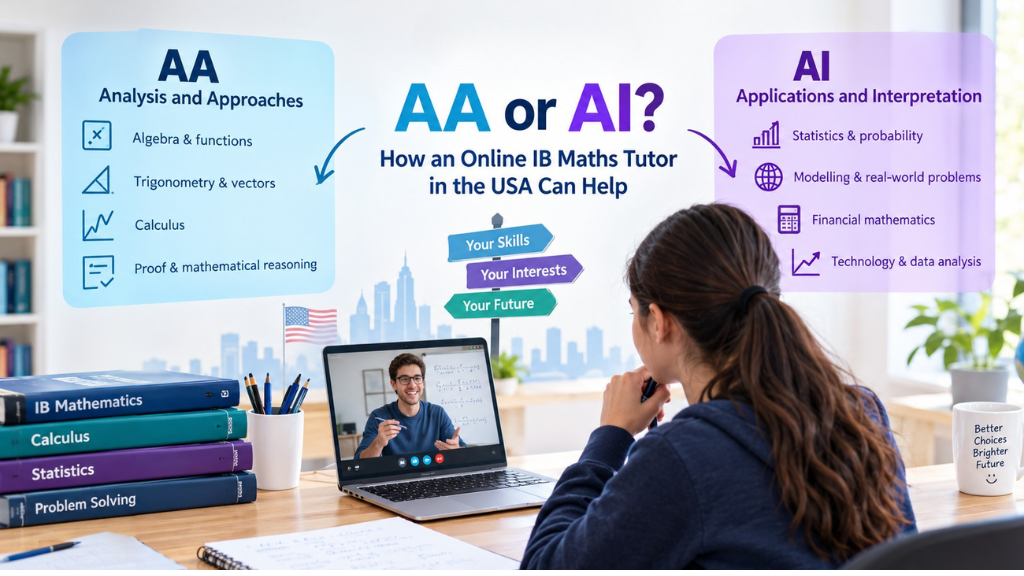
AA or AI? How Can an Online IB Maths Tutor in the USA Help You Choose and Succeed?
Few decisions in the IB Diploma feel as important as choosing between Analysis and Approaches (AA) and Applications and Interpretation (AI). The choice shapes your workload for two years, affects which university courses you can apply for, and influences how confident you feel every time you open a maths paper. Many students make the decision in a hurry, based on what friends are choosing or what seems easier. A skilled IB Maths Tutor in the USA can help you slow down, look at your strengths honestly, and pick the course that truly fits. This guide compares the two courses and shows how personalised online support can help you succeed in either one.
Understanding the Two IB Maths Courses
Both AA and AI are available at Standard Level (SL) and Higher Level (HL), and both are rigorous. The difference lies in the kind of mathematics each one emphasises and the way students are expected to use it.
IB Maths AA: Analysis and Approaches
AA focuses on mathematical theory, algebraic reasoning and proof. Students spend significant time on functions, equations, trigonometry, vectors, calculus and the logic that connects these ideas. At Higher Level, the course goes deeper into topics such as complex numbers, proof by induction and more advanced calculus techniques. The style is abstract and precise, which rewards students who enjoy manipulating expressions and justifying every step.
IB Maths AI: Applications and Interpretation
AI places more emphasis on statistics, modelling and real-world problem solving. Students work with data, probability distributions, regression, financial mathematics and graphical analysis, and they are expected to use technology such as a graphic display calculator regularly. Calculus is still part of the course, but the treatment is more applied. The style suits learners who like to see how maths describes real situations and who prefer interpreting results to proving general statements.
Comparing Syllabus, Difficulty and Assessment
Students often ask which course is harder. The honest answer is that they are difficult in different ways. AA is usually considered more demanding in terms of algebra and abstract reasoning, while AI challenges students to model situations, choose suitable methods and interpret answers in context. HL in either course is a major step up from SL in both content and pace.
Assessment follows a similar structure in both courses. Students sit external papers and complete an internal assessment, a mathematical exploration that they design, research and write up independently. In AA, one paper is taken without technology and another with it, whereas in AI technology is available across the main papers. HL students sit an additional extended paper. Because syllabus details are updated by the IB from time to time, it is wise to check the latest subject guide with your school or tutor before making a final decision.
Which Course Suits Which Student?
There is no universally better option. The right course depends on your skills, your interests and where you want to go after school. Consider the following points.
- Choose AA if you enjoy algebra, like abstract problem solving and are considering engineering, physics, computer science, mathematics or economics at a competitive university
- Choose AI if you prefer practical applications, feel comfortable with technology and are heading towards business, psychology, social sciences, geography or medicine-related fields
- Think about Higher Level if maths is a strength and your target course lists it as a requirement or strong preference
- Think about Standard Level if you want a solid qualification while leaving more time for subjects central to your intended degree
- Always check university requirements early, since entry expectations vary between institutions and programmes in the United States and abroad
The best choice is rarely obvious from a single test score. That is where an experienced tutor becomes valuable.
How an Online Tutor Helps You Choose the Right Course
A good tutor does not simply recommend a course. They help you gather evidence. Through a short diagnostic session, they can see how you handle algebra, graphs, data and unfamiliar problems. They can also talk through your interests and intended degree, then show how each path connects to your goals.
Families searching for an online IB Maths tutor in the USA often find that this early guidance prevents costly mistakes, such as switching courses halfway through the first year. Some students try sample lessons from both courses to see which style feels natural. Others discover that their strength in logical reasoning points toward AA, or that their love of data and real-world modelling points toward AI. Either way, the decision becomes informed rather than rushed.
Students who plan to study sciences can also benefit from joining maths and science support together. Since physics relies heavily on algebra, vectors and calculus, pairing maths lessons with an IB Physics tutor online in the USA helps ideas reinforce one another and makes both subjects easier to follow.
Benefits of Personalised Online Tutoring
Once you have chosen a course, the next challenge is mastering it. Personalised online tutoring offers advantages that classroom teaching alone cannot always provide.
Concept Clarity at Your Own Pace
In a busy classroom, a student who is confused about logarithms or probability may not get the time to ask follow-up questions. In a private session, the tutor can pause, try a different explanation and use visual tools such as interactive graphs and digital whiteboards until the idea becomes clear. Strong foundations in earlier topics are repaired before new ones are layered on top, which prevents the snowball effect that makes maths feel overwhelming.
Flexible Scheduling for Busy Students
IB students manage heavy workloads, from the Extended Essay to Theory of Knowledge and extracurricular commitments. Online sessions can be arranged in the evenings or at weekends across US time zones, with no travel time. Students can increase the frequency of lessons before internal assessment deadlines or exams and reduce it when the load is lighter.
Building Confidence and Independence
The goal of tutoring is not dependence. A tutor teaches methods for approaching unfamiliar questions, checking answers and learning from mistakes. Over time, students become more independent thinkers who can face a new problem calmly, which is exactly the mindset the IB rewards.
Exam Preparation and Internal Assessment Support
Knowing the content is only part of success. Students also need to perform well under timed conditions and present their work clearly.
Past Papers and Exam Technique
Tutors guide students through past papers, explain how marks are awarded and teach them to show method clearly so that follow-through marks are not lost. For AA students, this includes practising paper sections without a calculator. For AI students, it includes using the graphic display calculator efficiently and accurately. Time management techniques, such as deciding when to move on from a difficult question, are also built into practice.
Guiding the Mathematical Exploration
The internal assessment is a major piece of work that often overwhelms students. A tutor can help you brainstorm topics linked to personal interests, refine a clear research question, check mathematical accuracy and improve reflection and communication. This support keeps the project on schedule and raises the quality of the final report, while the ideas and writing remain the student’s own.
Targeted Revision Plans
In the final months, tutors create revision schedules that focus on weaker topics while maintaining strong ones. Regular mock tests and feedback sessions show progress and highlight any remaining gaps early enough to fix them. Many students find that this structured approach cuts down last-minute panic and builds real exam readiness.
Finding the Right Support
When choosing a tutor, look for solid experience with both AA and AI at SL and HL, clear communication and a teaching style that suits you. A trial session is a practical way to check whether explanations are easy to follow. Platforms such as TutorBoon help families connect with specialist IB tutors and arrange lessons around each student’s course, level and schedule.
Conclusion
AA and AI are both excellent courses, and neither is automatically the right or wrong choice. AA suits students who enjoy theory, algebra and proof, while AI suits those who prefer data, modelling and practical interpretation. What matters is matching the course to your strengths, interests and future plans, then supporting yourself with consistent practice and expert feedback. Working with an IB Maths tutor online in the USA gives you honest advice before you choose and structured support after you do, from concept clarity to exam preparation and the internal assessment. If you are ready to move forward with confidence, TutorBoon can help you take the next step.