
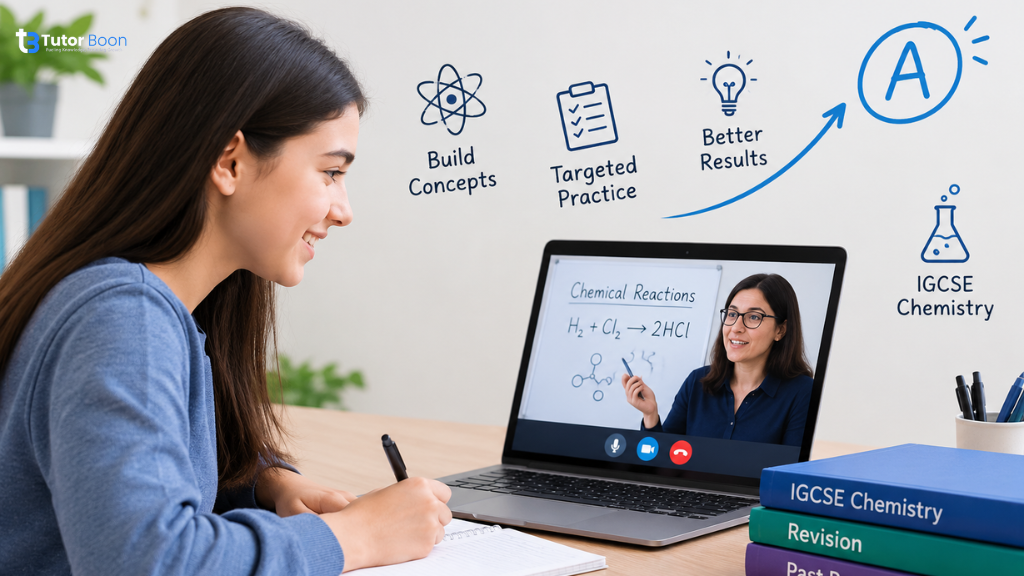
How Can an Online IGCSE Chemistry Tutor UK Help You Move From a C to an A?
Many IGCSE Chemistry students reach a point where their grades stall. They attend lessons, complete homework and revise before tests, yet results hover around a C. The frustrating part is that the gap between a C and an A is rarely about intelligence. It usually comes down to a handful of weak concepts, shaky exam technique and a lack of targeted feedback. This is exactly where an online IGCSE chemistry tutor in the UK families trust can make a difference. This guide explains the challenges that hold students back and shows how focused online support can lift your grade step by step.
Why IGCSE Chemistry Holds Students Back
Chemistry combines memorised facts, logical reasoning and mathematical skill. A student can be strong in one area and still lose marks in another, which is why progress can feel slow without the right support.
Understanding Chemical Reactions
Chemistry is built on ideas that cannot be seen directly. Symbols and diagrams represent atoms, ions, electrons and bonds, and students must connect those models to what actually happens in a reaction. Topics such as electrolysis, rates of reaction, equilibrium and organic chemistry require students to explain why something happens, not just describe it. When the underlying idea is unclear, students tend to memorise answers, and that approach breaks down the moment a question is worded differently.
Balancing Equations and Calculations
Balancing equations looks simple until state symbols, ionic equations and unfamiliar compounds appear. Mole calculations add another layer, since students must convert between mass, moles, concentration and gas volume with careful use of units. A small slip in the first step carries through the whole answer, so confidence drops quickly. Many students lose marks here, not because the chemistry is beyond them, but because they have never been shown a reliable method.
Solving Exam Questions
Exams reward precise language and clear structure. Students often know the content but write vague answers, miss the command word or fail to use the data provided. Longer questions that ask students to evaluate, compare or explain a trend can be especially difficult. Practical skills questions, such as planning an investigation or interpreting results, add yet another challenge because they depend on experience and careful reading.
How an Online Tutor Finds and Fixes Learning Gaps
The first step toward an A is knowing exactly where marks are being lost. A tutor begins with a diagnostic review of recent tests, homework and past paper answers. Instead of repeating the whole syllabus, they identify patterns: perhaps bonding is solid but stoichiometry is weak, or maybe calculations are fine but extended written answers lack detail.
Strengthening Concepts From the Ground Up
Once gaps are identified, the tutor rebuilds understanding in a logical order. A student struggling with the mole concept, for example, may need to revisit relative atomic mass and balanced equations before moving on to titration calculations. Interactive whiteboards, animations and diagrams help make abstract ideas visible, and the tutor can pause whenever something is unclear. Students who work with a one to one IGCSE Chemistry tutor UK often say that the biggest change is feeling free to ask questions they would never raise in a full classroom.
Personalised Lessons That Match Your Pace
Personalised lessons are planned around the student, not the class average. Strong topics are covered quickly so that time can be spent on the areas that need attention. The tutor adjusts the pace, the style of explanation and the level of challenge as confidence grows. This flexibility keeps students engaged, because every session feels relevant to their own goals rather than repeating material they already know.
Revision Strategies That Move Grades Upward
Reading notes again and again feels productive but rarely raises marks. Effective revision is active, targeted and regular. A good tutor teaches students how to revise as well as what to revise. Useful strategies include:
- Active recall: closing the book and writing down everything you remember about a topic before checking your notes
- Spaced repetition: returning to topics at increasing intervals so facts stay in long-term memory
- Flashcards for key terms: testing definitions, reactivity series, test results and organic families
- Equation practice: balancing a few equations every day until the method becomes automatic
- Topic summary sheets: one page per topic with key ideas, formulae and common mistakes
- Timed questions: short bursts of exam-style practice to build speed and accuracy
Tutors also help students build a realistic revision timetable that covers every topic and leaves time for repeated practice before the exams.
Past-Paper Practice and Exam Technique
Past papers are the most valuable revision tool available, but only when they are used properly. Simply completing a paper and checking the score does not lead to improvement. The real benefit comes from analysing every lost mark.
Learning From the Mark Scheme
A tutor goes through each question with the mark scheme, showing how examiners award points and which key phrases they look for. Students learn what a full-mark answer looks like and begin to write in the same precise style. Over time, vague statements such as “it reacts faster” turn into specific explanations involving collision frequency and energy.
Mastering Command Words and Time Management
Words like state, describe, explain, suggest and evaluate each call for a different type of answer. Tutors train students to match their response to the command word, use the number of marks as a guide to how much detail is needed and show full working in calculations so that method marks are not lost. Timed practice also teaches students how long to spend on each question and when to move on.
Handling Practical and Data Questions
Students are shown how to read graphs, spot anomalous results, suggest improvements to an experiment and write clear conclusions. These skills can lift marks across the whole paper because many questions rely on interpreting information rather than recalling facts.
Regular Feedback and Steady Progress
Improvement from a C towards an A rarely happens overnight. It builds through small gains that add up. Regular feedback is what keeps those gains moving in the right direction. After each session, the tutor reviews what went well, what still needs work and what to practise before the next lesson. Short topic tests and mock papers measure progress against clear targets, so students and parents can see improvement rather than guess at it.
This steady loop of practice, feedback and correction builds both knowledge and confidence. Students who once dreaded unfamiliar questions begin to approach them calmly, because they have a method they trust.
Balancing Chemistry With Your Other Subjects
IGCSE students usually study a wide range of subjects, and time becomes tight in the final year. Some families choose support across more than one subject so that every lesson moves the student closer to their target. For instance, a student who wants to raise their results in both a science and a social science may work with a one to one IGCSE economics tutor UK alongside their chemistry lessons. Sharing a consistent routine across subjects, such as weekly review sessions and regular past paper practice, helps students stay organised and reduces last-minute stress. Online lessons make this much easier to manage, since there is no travel and sessions can be fitted around school, sports and other commitments.
Choosing the Right Tutor
When searching for support, look for a tutor with strong knowledge of your exam board, whether Cambridge or Edexcel, and a record of helping students raise their grades. Ask how they structure lessons, how often they provide feedback and whether they use real past papers. A short trial session is a good way to see if their explanations suit your learning style. Platforms such as TutorBoon make it easier to find specialist IGCSE tutors and arrange lessons that fit a student’s timetable and goals.
Conclusion
Moving from a C to an A in IGCSE Chemistry is realistic with the right plan. The path involves finding learning gaps, strengthening concepts, practising balanced equations and calculations, and learning how examiners expect questions to be answered. Working with an online IGCSE Chemistry tutor UK gives you personalised lessons, targeted past paper practice and regular feedback that turn effort into results. Be patient, stay consistent and keep practising, because every improvement adds up. If you are ready to start your journey toward a higher grade, TutorBoon is ready to support you.
Frequently Asked Questions:
1. How can an online IGCSE Chemistry tutor in the UK help me improve from a C to an A?
An online IGCSE Chemistry tutor identifies learning gaps, strengthens difficult concepts, and provides targeted revision, past-paper practice, and personalised feedback to help you improve your grades.
2. Is online IGCSE Chemistry tuition effective for students struggling with the subject?
Yes, online tuition provides one-to-one support, allowing students to ask questions, revisit difficult topics, and learn at their own pace with focused guidance.
3. Which IGCSE Chemistry topics do students find most difficult?
Commonly challenging topics include mole calculations, chemical bonding, electrolysis, organic chemistry, balancing equations, rates of reaction, and practical-based questions.
4. How can an IGCSE Chemistry tutor help me prepare for exams?
A tutor helps students practise past papers, understand mark schemes, improve answers to command words, manage exam time, and identify recurring mistakes.
5. How often should I take online IGCSE chemistry tuition?
One or two sessions per week can provide a useful starting point. The ideal frequency depends on your current understanding, target grade, exam date, and revision schedule.